How Much Does It Cost to Build a Pond in Texas?
The extension service’s 2026 Texas custom rate survey puts stock tank construction at an average of $167.59 an hour. Reports ran from $100 to $300, and the most common rate was $200. Each rate includes operator, machine and fuel. In Texas a farm pond is often called a stock tank, the survey’s name for this work.
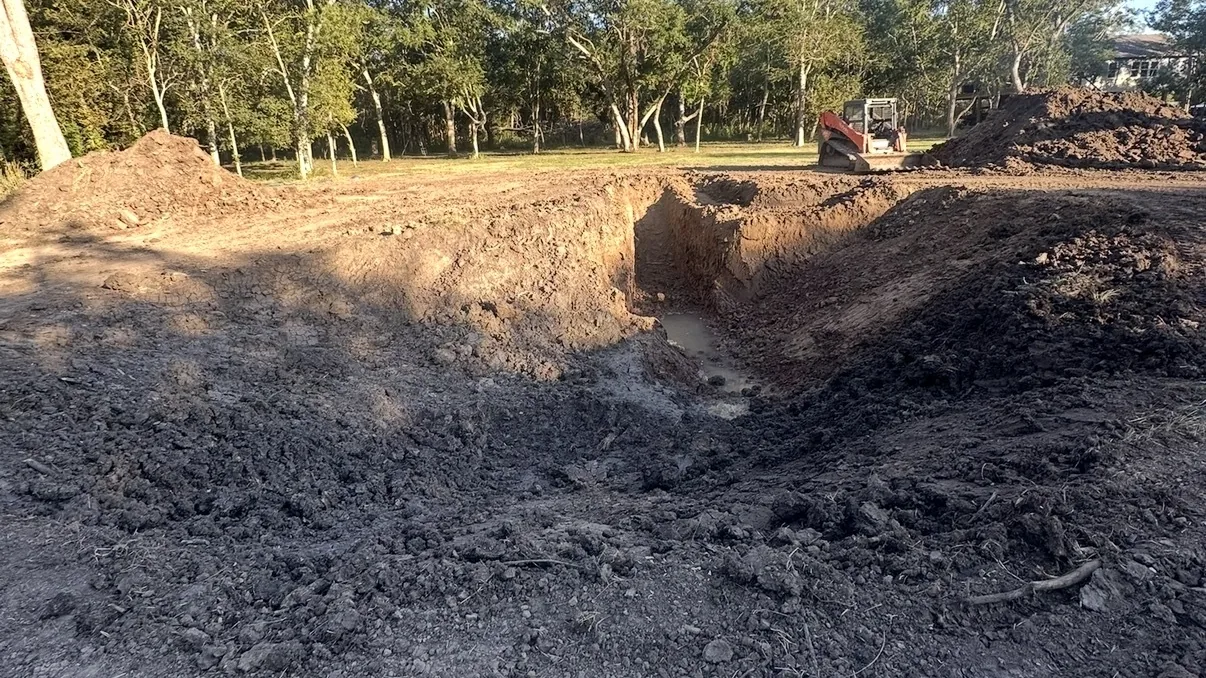
National cost guides price the whole pond. One guide, updated in January 2026, puts ponds under 10 acres at $3,000 to $15,000 per acre. It prices digging a large pond at $1.50 to $4.00 per cubic yard. These are market numbers, not our price list. Our pond construction page shows how we dig new ponds and expand old ones around Katy, Texas.
What does the Texas custom rate survey say a stock tank costs?
This edition surveyed providers and users of custom farm work from August through October 2025. The stock tank line drew 27 responses.
| 2026 survey: stock tank construction and upkeep | Per hour |
|---|---|
| State average | $167.59 |
| Most common rate | $200 |
| Lowest and highest reports | $100 and $300 |
| Averages in the survey’s four regions | $161 to $175 |
The regional averages sit close together, so the state figure is a fair guide around Katy. Hours, and so the cost to dig a pond, follow how much dirt has to move.
What do national cost guides say a pond costs?
Guides set pond construction cost by size or acre, or by the cubic yard. The January 2026 guide lists these totals:
| Pond size | Published range, January 2026 guide |
|---|---|
| A quarter acre | $1,800 to $8,100 |
| Half an acre | $2,400 to $11,600 |
| 1 acre | $3,000 to $15,000 |
| 2 acres | $6,000 to $30,000 |
| 4 acres | $12,000 to $60,000 |
The same guide puts a farm pond at $3,000 to $23,000 on average. It describes farm ponds as a quarter acre to 5 acres, 6 to 12 feet deep. A second guide, updated in December 2025, puts a farm pond at $3,750 to $13,000, depending on size and terrain. Its per acre price drops as ponds grow, to $1,400 to $4,800 at 10 acres and more.
What drives the price of a pond?
Size and depth. The federal pond handbook says a dug pond gets its capacity almost solely from excavation. Each added foot of depth or acre of water is more dirt to move.
Dug below grade or held by a dam. The extension service says dug ponds are normally built on relatively flat land. Ponds held by an embankment suit sloping ground, and one cost guide says sloped sites take more labor. Most ground around Katy is flat prairie. State law bars holding back surface water in a way that floods and damages another person’s property.
Soil that holds water. The handbook says the best sites have fine-textured clay and silty clay well below the planned depth. Where soil lacks enough clay to stop seepage, it describes a clay blanket over the whole area the water covers. The blanket needs at least 20 percent clay, compacted at least 12 inches thick for water under 10 feet deep. Both cost guides put a geotechnical soil report at $1,000 to $5,000.
Toward Rosenberg and East Bernard, the federal soil survey describes Lake Charles clay, which takes in water very slowly once wet. Around Katy, Brookshire and Fulshear, the Katy series has a seasonal perched water table in the upper soil in the cool months. The extension service warns that a perched water table makes an unreliable source for a dug pond.
Clearing the site first. The handbook’s first building step is clearing the pond area of unwanted vegetation. The same extension survey averages $144.23 an hour for a dozer under 160 horsepower clearing land. Our forestry mulching clears brush around a pond and leaves it mulched in place.
Where the dug dirt goes. The handbook says to plan for the dug material before digging starts. The toe of the fill, its bottom edge, must sit at least 12 feet from the pond’s edge. Dug dirt can fill nearby low areas or build farm roads, shaped to blend with the land. One cost guide counts whether the dirt stays on site. We have built a pad from the clay and sand dug out of a pond. Our dirt work page covers pads and grading.
Banks and a livestock ramp. For cattle, the handbook calls for a ramp with a flat slope of 4:1 or flatter. That is at least four feet across for every foot of drop.
Access and wet clay. One cost guide says labor costs more when trucks or large equipment have trouble reaching the site. Wet clay is slow, heavy going for machines.
Expanding an old pond. The handbook says to build a pond so it can be enlarged if it proves too small. We expand existing ponds. When one owner started his own pond and got overwhelmed, we built it the way he asked.
Do you need a permit or a water right for a pond in Texas?
State law lets you build a dam or reservoir on your own property without a water-right permit. Its normal storage has to stay at 200 acre-feet or less, for domestic and livestock use. The exemption does not apply to a commercial operation.
In unincorporated Fort Bend County, a permit is required for fill placement or excavation over 500 cubic yards per acre. A change in any elevation of 6 inches or more needs one too, and so does work in a floodplain. The county sends owners to the federal flood maps to check a property. Inside city limits, the city decides.
The state environmental agency regulates construction stormwater when work disturbs an acre or more of soil and drains to surface water. A one acre pond plus the ground where its dirt is spread passes that line.
Do you need to call 811 before digging a pond?
Texas law treats machine digging 16 inches deep or more as excavation, and a pond goes far deeper. Notice goes to the 811 center at least 48 hours before digging and no more than 14 days ahead. Weekends and legal holidays do not count. The law exempts agricultural operations on private property. The state agency that enforces it still tells homeowners and contractors to call. Lines that serve only the owner, such as a well line to a barn, fall outside the law. Point those out before a machine digs.
What should a written pond quote spell out?
Ask for these in writing:
- The size and depth, and whether the pond is dug below grade or held by a dam
- How the soil was checked, and the plan if it will not hold water
- What clearing is included, and where the dug dirt goes
- The bank slopes and any livestock ramp
- Whether a county permit or floodplain check applies
- Whether the price is by the hour or for the whole pond
How do you get a pond quote around Katy?
We dig new ponds and expand old ones on acreage around Katy, Texas and the west side of Houston. Our pond construction page shows how we build them, and our excavation page covers the rest of our digging. We look at the job and put the quote in writing. Call or text (979) 824-2296 with the pond size you have in mind.