How Much Does Small Acreage Land Clearing Cost in Texas?
One national cost guide’s 2026 Houston page puts land clearing at about $550 to $6,200 an acre. The same page puts the average job near $4,148. Thin brush sits at the low end, and dense woods push an acre to the top.
The guide’s state table puts the average Texas clearing job at $3,520. These are market numbers from published guides, not our price list.
We handle land clearing on lots and tracts of 10 acres or smaller. We serve Katy and the west side of Houston, and the figures below stay with ground that size.
How much does an acre cost to clear, light brush versus thick woods?
How thick the growth is sets most of the price. The Houston page splits its numbers into lightly and densely wooded ground.
| Tract size | Lightly wooded | Densely wooded |
|---|---|---|
| 1/2 acre | $275 to $1,100 | $2,000 to $3,100 |
| 1 acre | $550 to $2,200 | $4,000 to $6,200 |
| 2 acres | $1,100 to $4,400 | $7,900 to $12,300 |
| 5 acres | $2,800 to $11,000 | $19,800 to $30,800 |
The same page says Houston clearing runs nearly 10 percent over the national average. It points to clay-heavy soil and wet ground. Another national guide, updated in November 2025, adds a middle level between light and heavy.
| Growth | What stands on the acre | Cost per acre |
|---|---|---|
| Light | Shrubs and small trees | $1,200 to $2,500 |
| Moderate | Thick underbrush and medium trees | $2,500 to $4,500 |
| Heavy | Dense brush and large trees | $4,500 to $8,000 |
Texas farm and ranch numbers fill in the light end. They come from the state extension service’s 2026 survey of hired machine work. Pasture shredding averaged about $47 an acre.
Grubbing out about 40 small trees or shrubs an acre, roots and all, averaged about $168 an acre. A dozer clearing land averaged $144 an hour under 160 horsepower and $176 above it. Those hourly rates include fuel and the person running the machine.
Why does a half acre cost more per acre than 5 acres?
The machines make the same trip to a half acre as to 5 acres. On a small lot, that setup spreads over fewer acres. Guides also list minimum charges for small jobs.
The November 2025 guide lists a half acre at $1,000 to $5,000. It lists 5 acres at $4,500 to $35,000, which works out lower per acre.
Does mulching in place cost less than hauling brush off?
Usually, because the brush never leaves the property. Forestry mulching grinds brush and small trees where they stand. The chips stay on the ground as a mulch layer.
National guides put forestry mulching at about $500 to $2,500 an acre. Some jobs price by the hour instead, at $150 to $300 an hour in one 2026 guide.
Hauling adds trucks and dump fees to the bill. One national guide prices debris hauling and disposal at $300 to $1,000 per load. Its Houston page lists dumpsters from 10 to 40 yards at $250 to $875.
Mulching has limits. The November 2025 guide says it suits trails and pasture upkeep but not building sites. The roots stay in the ground, so some brush sprouts back.
The state extension service says Chinese tallow has grown dense on many sites across the Texas Coastal Prairie. It also says tallow resprouts quickly from crown and root buds once the top growth is mechanically removed.
Burning is a narrow option around Katy. Fort Bend and Harris counties are among the Houston-area counties that miss the federal ozone standard. In those counties, the state allows burning land-clearing brush only when no practical alternative exists. The state’s outdoor burning guide lists mulching as one alternative.
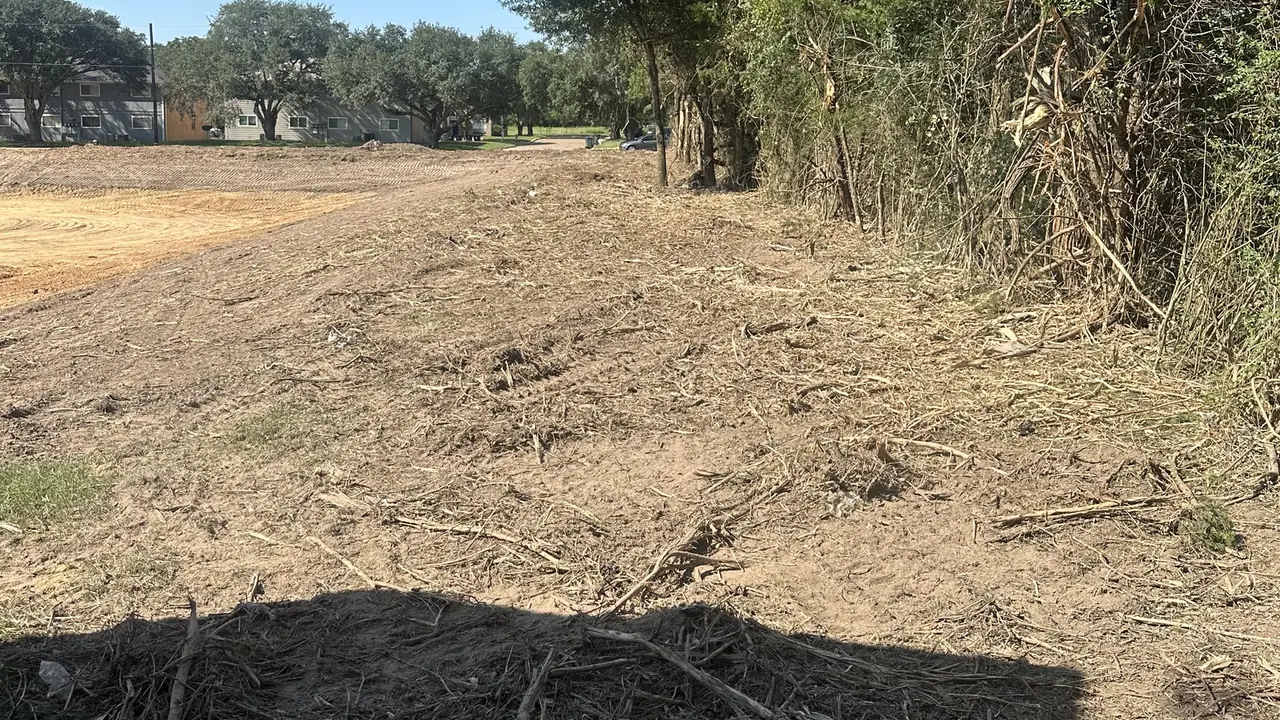
Mulching in place is how we handle brush where that fits the job. Where material has to leave, we load it out and the trucking is arranged. Our forestry mulching page shows what the mulching head leaves behind.
What does a build site need after clearing?
A house site needs more than cleared ground. The November 2025 guide says clearing with dozers and excavators works well before construction. That method removes everything above and below ground.
Grading comes next. The same guide puts grading a small home site on mostly level land at $2,000 to $5,000. A 2026 national guide lists grading and leveling at $1,000 to $3,300. It lists a land survey at $800 to $5,500.
Fort Bend County adds its own steps outside city limits. Its home permit checklist asks for a survey or site plan and a simplified grading plan.
The county drainage district’s rules for rural subdivisions set a slab at least 2 feet above natural ground. Near a floodplain or a road, the required height can be greater. The same rules keep major grading on those lots to lot line swales and building pads.
Raising a slab 2 feet takes fill, and fill is its own cost. Our house pad and grading work picks up where clearing stops.
In Fort Bend County, a new drive off a county road needs a permit of its own. Our guide to driveway culvert permits in Fort Bend County covers who issues it.
Do you need a permit to clear land in Texas?
Start with who has the say. Inside city limits, the city’s permit office decides. Outside them, the county does. Inside Katy, grading or fill in a mapped flood zone needs the city’s floodplain development permit.
In Fort Bend County outside city limits, the county engineering office issues development permits. Its permit page lists work in a mapped floodplain. It also lists fill or digging past 500 cubic yards an acre. A grade change of 6 inches or more counts too.
The state’s construction stormwater permit is the next check. It counts clearing as construction activity once a project disturbs 1 acre or more.
Sites of 1 to 5 acres need a stormwater pollution prevention plan before work starts. Sites of 5 acres or more also file a notice of intent with the state. Clearing ground for crops and similar farm work falls outside the permit.
Pulling roots and stumps can dig 16 inches deep or more. State law asks anyone digging that deep with machines to notify 811 first. The notice goes in at least 48 hours ahead, weekends and holidays excluded.
Farm and ranch work on private land is exempt. The state’s pipeline safety agency still recommends the call on any dig. Private lines, like a water well line, are not marked, so point them out before work starts.
How do you get a real number for your land?
Two 5-acre tracts can land more than $20,000 apart in the Houston table. The real number comes from seeing the growth and settling where the brush goes. A written quote should say what the ground looks like when the machines leave.
Read how our land clearing for lots and small acreage works, then call or text (979) 824-2296. We look at the job and put the quote in writing.